Study modes
Six ways to make knowledge stick.knowledge stick.
Flashcards are the beginning, not the end. Learn, match, test, practice daily, set goals — each mode attacks retention from a different angle.
Study cycle
Every answer schedules the next one.
Question
Where does the Krebs cycle take place?
tap to flipAnswer
The mitochondrial matrix
where the Krebs cycle takes place
Next review · in 3 days
Answer well and the gap grows. Miss, and the card comes back tomorrow.
Flashcards work — until they feel like a chore. When the same front/back loop gets stale, you stop showing up. Multiple study modes keep practice engaging across weeks and months of review.
The modes
Every angle of active recall.
Each mode serves a different moment in your study session — from first exposure to exam simulation.
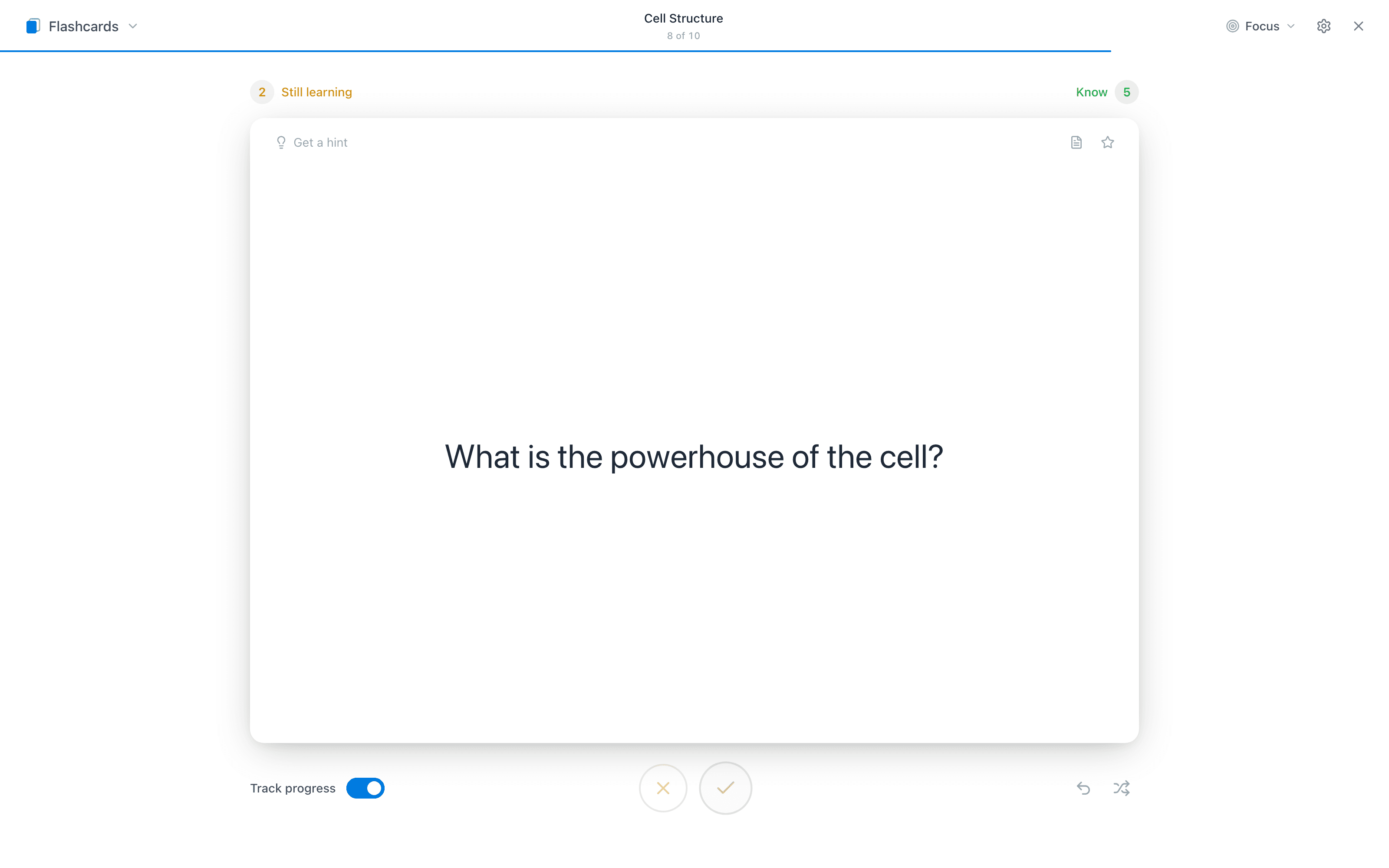
Flashcards
Classic front/back review with spaced repetition scheduling. Cards resurface at optimal intervals based on your performance. Rate difficulty and watch intervals grow as mastery builds.
Learn
Guided study for new material. Mento introduces cards progressively, mixing new items with recent ones until you've seen everything. Built for first-pass learning before SRS takes over.
Match
Connect terms to definitions against the clock. Fast-paced recall that builds the neural speed you need for timed exams. Great for element lists, vocabulary, or anatomy.
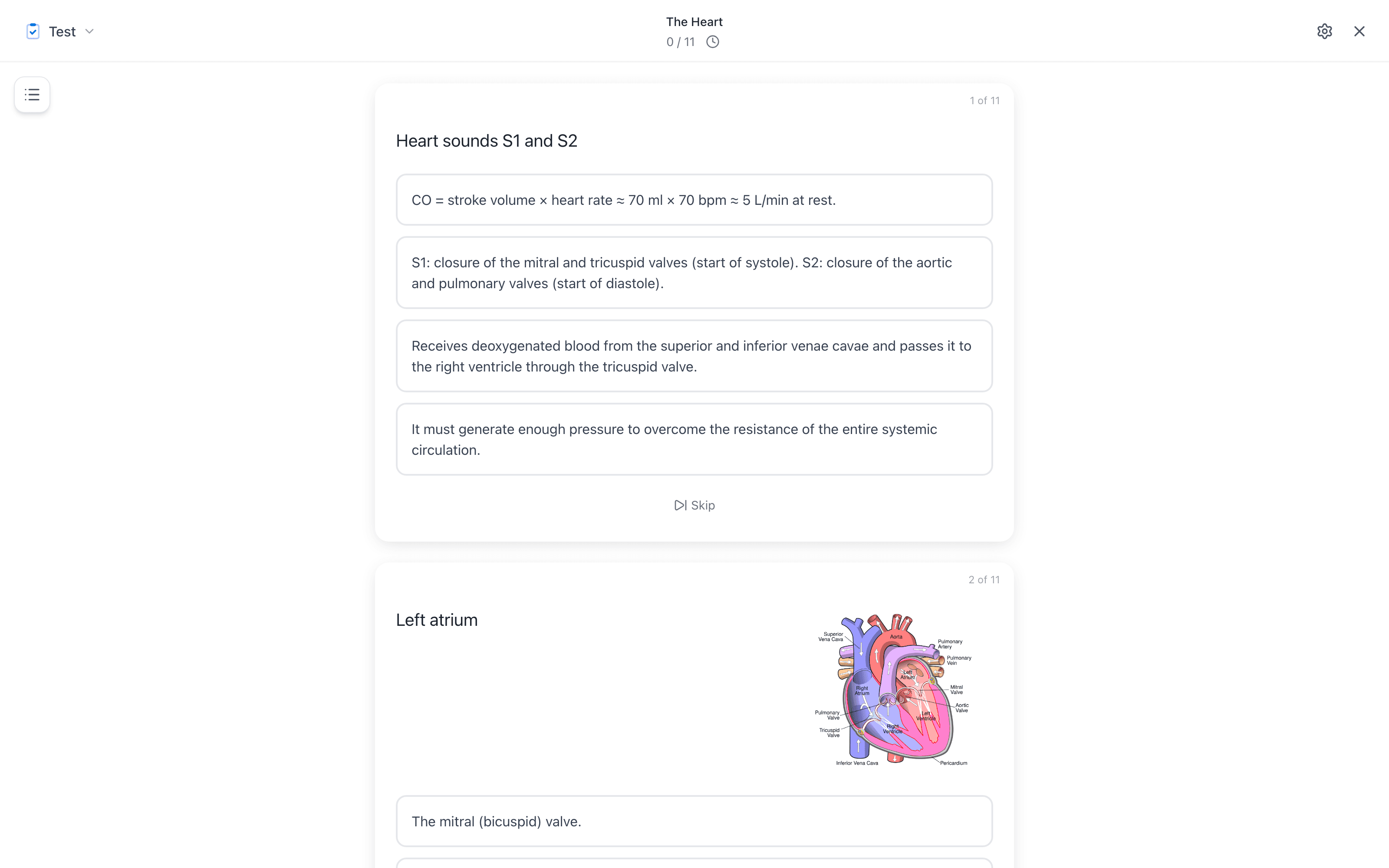
Test
Simulated exam conditions. Multiple choice, written answer, or true/false — generated from your cards. Set a time limit. Get scored. Review mistakes immediately.
Daily practice
Your morning queue. Cards due today from across all spaces, served in priority order. Finish your queue, maintain your streak. The compound interest of consistent review.
Goals & weak-spot detection
Set targets and Mento adapts. It tracks mastery per topic and space, identifies where you're weakest, and prioritizes those areas in your daily queue. Not a dumb timer — an adaptive system that focuses your effort where it matters most.
Goals
Show up every day.
Daily goal — 20 min
14 of 20 minutes today
Last 14 days
Mastery
Watch it click into place.
Latest test
Cellular Biology 101 · 24 questions
88%
+14
Under the hood
Spaced repetition, explained simply.
How does scheduling work?
Each card has an interval that grows as you answer correctly. Get it right → see it later. Get it wrong → see it sooner. The algorithm optimizes for long-term retention with minimal daily reviews.
How does Mento know where I'm weak?
Mento tracks mastery at every level — per card, per topic, per space. It surfaces patterns: if your Renal cards are slipping while Cardio is strong, your daily queue re-prioritizes automatically. You see exactly which areas need attention without guessing.
Can I study by topic or space?
Yes. Study a single topic, an entire space, or let Daily Practice pull from everything. Scoped review for focused sessions, global review for maintenance.
What if flashcards feel stale?
Switch to Match for speed-based recall, or Test mode for exam simulation. Different modes create different memory traces — variety strengthens retention.
How the full scheduler works — the ladder, exam dates, and pacing →
Part of the loop
Study modes are verb three. The loop starts earlier.
Docs
How it works, step by step
Practice that adapts to you.
Six study modes. Spaced repetition scheduling. Progress tracking. Free to start.