For self-learners
A second brain that actually remembers.actually remembers.
Most PKM tools are where ideas go to die. Mento is different — it doesn't just store what you capture. It brings things back to you with adaptive spaced repetition, so what you learned in March still lives in December.
You highlight books, save articles, clip podcast quotes, take course notes. Six months later you can't remember any of it. The problem isn't your memory — it's that your "second brain" is a storage system with no retrieval loop.
The loop other PKM tools miss
Capture → Structure → Remember.
Every second brain app does the first step. Some do the second. Almost none do the third. But the third step — active recall and retention — is what turns saved information into usable knowledge.
Capture from anything
Books, articles, podcasts, videos, conversations. Quick capture for passing thoughts. PDF reader for deep reading. AI snippets for when you need help articulating an idea. Everything lands in one system.
Give ideas an address
Organize into Spaces and Topics that reflect how you think — not how an app thinks. Every card holds one idea — atomic notes, by design — so thoughts stay movable instead of buried in documents. Tag across boundaries. Build a structure you'll actually navigate, because structure is what makes retrieval possible.
Turn knowledge into practice
The step every other PKM tool skips. Turn your notes into flashcards — manually or with AI. The act of formulating what you know as testable questions deepens understanding immediately.
Retain with adaptive review
Spaced repetition that knows where you're weak. Mento tracks mastery per topic and space, reprioritizes what's slipping, and serves your daily review in order of need. What you captured in March still lives in April.
Quick capture
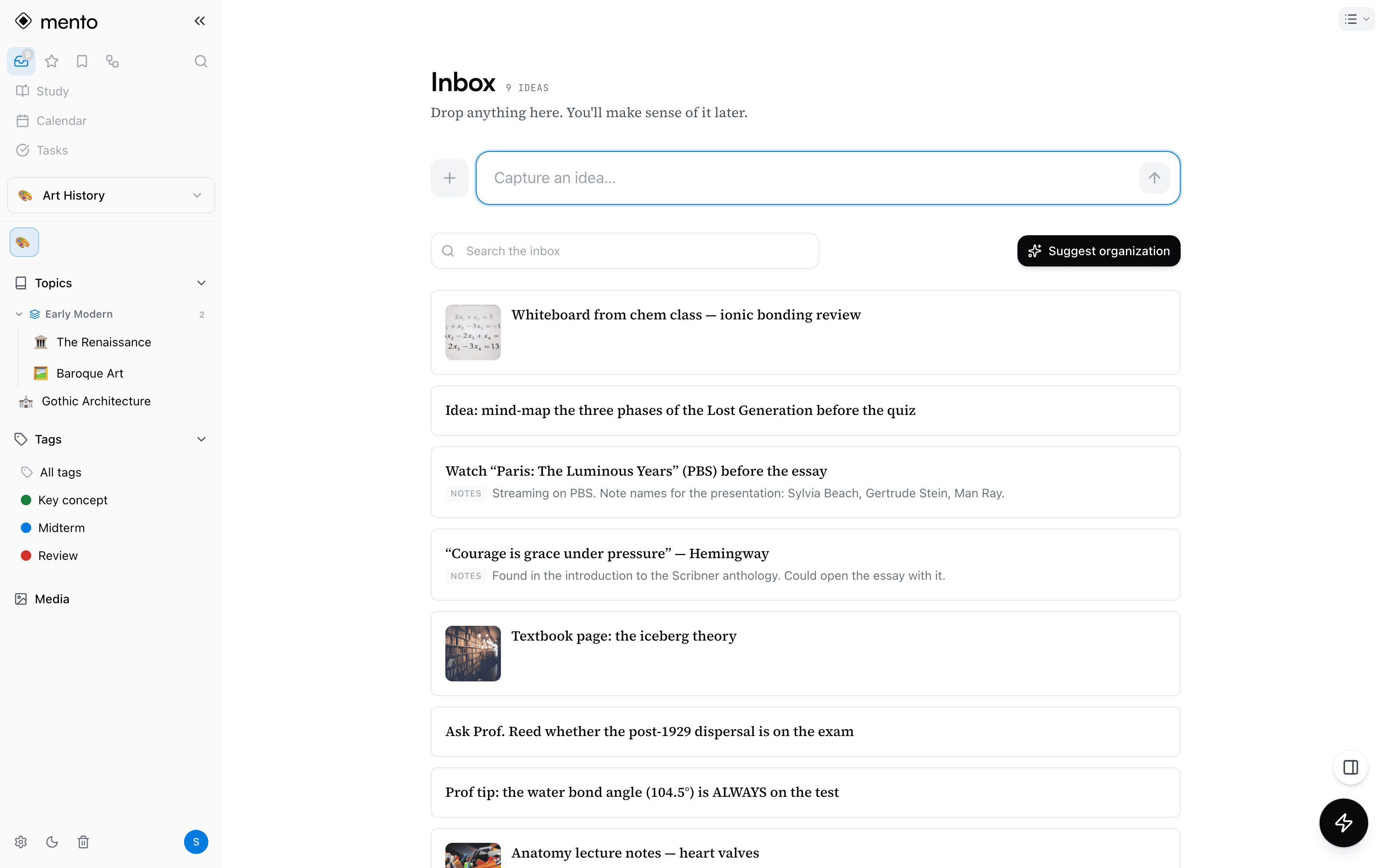
Catch a thought any way it arrives.
What you get
The tools that make knowledge stick.
Not a wiki. Not a project manager. A personal knowledge system built for one purpose: turning what you consume into what you retain.
Quick capture
Thought arrives, friction disappears. Capture from anywhere — a quick note, a pasted link, a dropped file, a voice memo transcribed. The gap between having an idea and saving it should be zero.
PDF reader + annotations
Read books and articles in-app. Highlight passages, annotate margins, and extract key ideas into your note system — no switching tools, no copy-pasting between apps.
Spaces & Topics
Hierarchical organization that mirrors how you think. Spaces for domains, Topics for concepts, Sections for sub-ideas. Not flat folders — a knowledge architecture.
AI-powered card generation
Select any note or highlight and AI generates recall-ready flashcards. The bridge between passive reading and active retention — automated.
Adaptive spaced repetition
Not a dumb timer. Mento tracks mastery per topic, identifies weak areas, and reprioritizes your daily review queue. It learns where you're strong and where you're forgetting.
Multiple study modes
Flashcards for daily review. Learn mode for new material. Match for speed recall. Test for self-assessment. Variety prevents the staleness that kills study habits.
AI Flows
Multi-step AI pipelines that process your captured content. Run a flow on a chapter and get organized sections, timelines, or card sets — turning raw input into structured knowledge.
Diagrams & sketches
Generate flowcharts, mindmaps, and concept maps from descriptions. Draw on cards with pen and highlighter. Visual encoding strengthens what text alone can't hold.
How it's different
Storage is not retention.
Notion, Obsidian, and Logseq are excellent at storing and connecting information. But they rely on you to remember to revisit things. Nothing surfaces forgotten knowledge. Nothing tells you what's slipping. Mento closes that gap: it stores like a PKM tool and retrieves like a study system — because what's the point of a second brain that forgets?
Notion / Obsidian
Capture + organize beautifully
No active recall, no SRS, no retention
Anki / Quizlet
Spaced repetition
No note-taking, no PDFs, no structure
Mento
Capture + organize + adaptive SRS
The full loop in one tool
Why structure matters
Organization is a memory system.
Your brain retrieves information through association — context, relationships, adjacency. When a note lives inside a well-structured Space, alongside related cards and source material, the organizational hierarchy itself becomes a retrieval cue. A second brain that mirrors how you think is a second brain you can actually remember from.
Spaces for domains
Philosophy, Programming, Health, Spanish — whatever you're learning gets its own space.
Topics for depth
Nest concepts inside domains. Stoicism → Epictetus → Dichotomy of Control. As deep as you need.
Cards for retention
Each card inherits its structural context. Review scoped by domain, topic, or everything at once.
It learns you back
Mento knows where you're forgetting.
Not all knowledge decays evenly. Mento tracks mastery across every space and topic, identifies what's slipping, and adapts your daily practice to focus where you need it most.
Per-topic mastery tracking
See exactly where you stand — not just overall, but per Space and per Topic. Your Philosophy space might be strong while your Spanish vocabulary is slipping.
Adaptive daily queue
Daily Practice doesn't just serve what's due — it prioritizes weak areas. The topics you're forgetting get served first. Compound interest for your knowledge.
Smart goals
Set mastery thresholds, not just card counts. "I want 80% mastery across all topics in my Programming space" — and Mento tells you what to do to get there.
Streaks that matter
Consistency compounds. Track your review streak, but more importantly — watch mastery percentages climb over weeks and months. Proof that what you're learning is sticking.
Docs
How it works, step by step
A second brain that brings things back.
Capture from anywhere. Organize with structure. Retain with adaptive review. Free to start.